

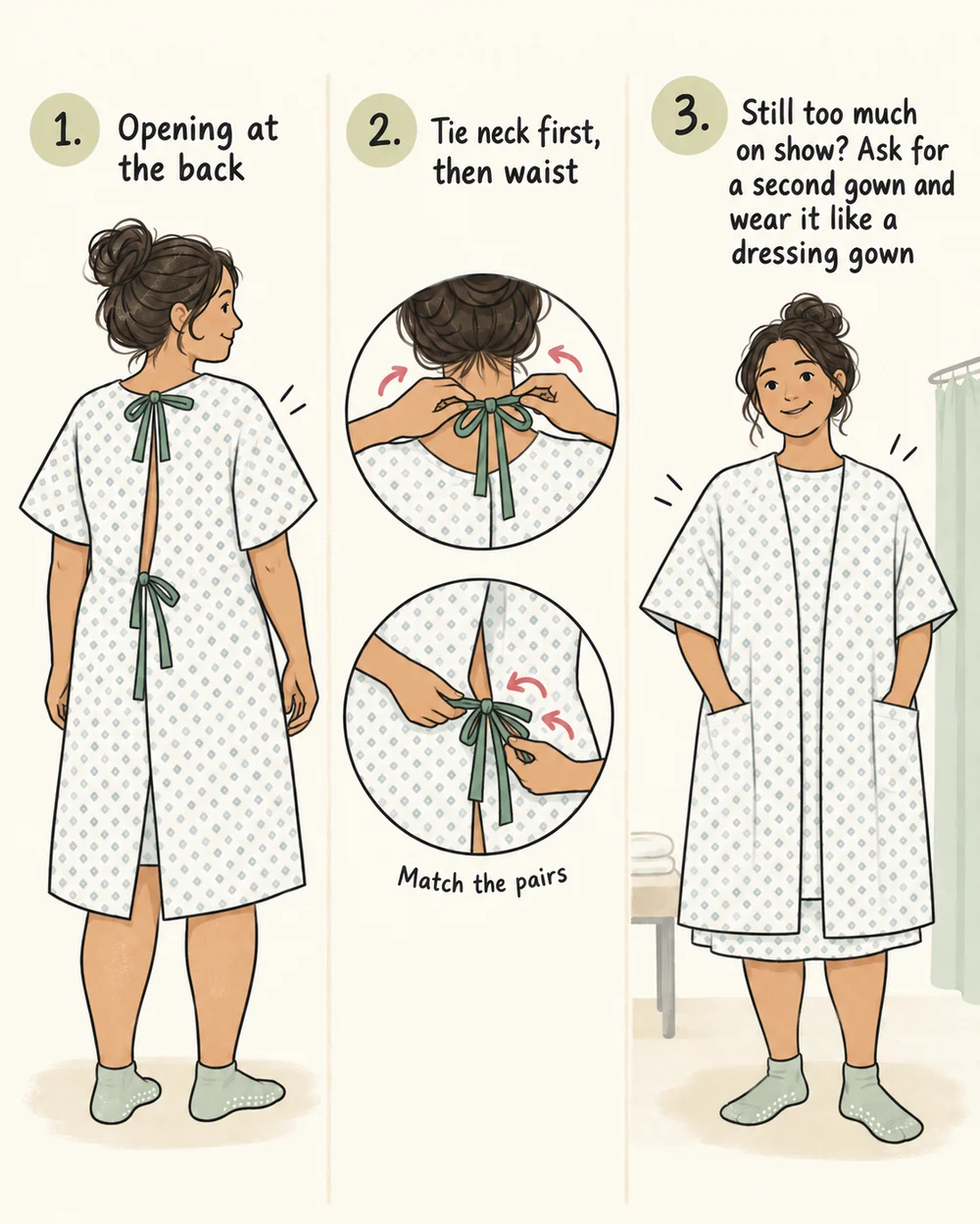
The quick version
1. The opening goes at the back.
2. Put your arms through the sleeves.
3. Tie the neck first.
4. Then tie the waist.
5. If there is still rather too much of you on public display, ask for a second gown and wear that one like a dressing gown, open at the front.
Which way round does it go?
For the bog-standard hospital gown, the opening goes at the back.
Put your arms through the sleeves like you’re putting on a dressing gown backwards.
If the gown has overlapping panels at the back, pull them across each other as far as they comfortably go.
Do not spend ten minutes turning it round and round looking for the “front”. There usually isn’t anything useful to tell you. This is one of those situations where the garment simply expects you to know things.
The damn ties
This is the bit nobody explains.
Most of these gowns have one pair of ties around the neck and another pair around the waist.
Tie the neck pair first.
Then find the waist ties. On many of the standard gowns, these meet more towards the side rather than directly in the middle of your back.
If the ties are colour-coded, match the same colours together.
You are not meant to gather every loose string you can find into one heroic knot somewhere behind your spine.
And if tying the thing requires shoulder flexibility normally associated with circus performers, ask somebody to do it for you.
This is not a test.
Am I supposed to be naked underneath?
Ask. Do not guess, because if you can save the world from seeing your naked bottom, you’ll probably want to.
What you can keep on underneath varies depending on the procedure and what staff need access to.
You may be able to keep your underwear on. You may not.
Let the staff tell you what actually needs to come off rather than assuming that “hospital gown” automatically means “everything off, dignity abandoned”.
My arse is still out
This is unfortunately often the gown doing exactly what it was designed to do rather than evidence that you’ve put it on wrong.
If there is still rather more of you available to the general public than you would prefer, ask for a second gown.
Put that one on the normal way round, like a dressing gown, with the opening at the front.
Gown number one gives the clinical team the access they need.
Gown number two stops your journey down the corridor becoming an unexpected lunar event.
Everybody wins.
What if I already have a cannula, line or drain?
Do not attempt hospital-gown Twister.
If getting the gown on or off means threading fabric around a cannula, drip line, drain or anything else attached to you, ask staff to help.
They do this all day, and they have seen every kind of body going — scars, stretch marks, cellulite, stomas, wobbly bits and all. They are considerably less interested in your naked bottom than you are.
Their job is to get you safely and comfortably into the thing, not to judge what’s underneath it.
Three things nobody tells you
1. You are allowed to ask for help tying it.
2. You are allowed to ask for a second gown if your backside is still making an unscheduled public appearance.
3. If you can’t work out how the gown goes on, that is a design failure, not an intelligence test.
The important bit
Hospital gowns, procedures and local instructions do vary.
If staff give you different instructions, follow those. And if you’re unsure about what can stay on underneath or how to deal with a line, cannula or drain, ask.
The gown may be ridiculous.
The question isn’t.
This is practical patient guidance, not medical advice. Hospital gowns, procedures and local instructions vary, so follow the healthcare team’s instructions for your procedure or treatment.
Printed from thesicklist.co.uk/guides/how-to-put-on-a-hospital-gown